CC-RICD
Introduction
The electron-repulsion integral (ERI) in atomic orbital basis is a four-index tensor:

The structure of ERI is sparse, and therefore a linear expansion over the products of particular one-electron functions, such as  , is able to representing the “densities”. The resolution-of-identity (RI) method is also called the density-fitting (DF) method. For both RI and Cholesky decomposition (CD) methods, the ERI is approximated by the following form:
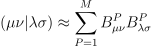
where  is the rank of the decomposition, which depends on the target accuracy. RI and CD methods uses different decomposition matrices
  . The RI method uses the auxiliary basis set, while the CD method uses the Cholesky decomposition of the ERI tensor.
For RI method, it expands product densities  in an auxiliary basis set:

Indices P and Q denote auxiliary basis functions, and the  is the metric tensor:

The auxiliary basis expansion coefficients  are obtained by minimizing the difference between the actual and fitted product densities, leading to the following set of linear equations:
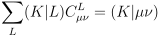
We define new auxiliary basis coefficients  :
:
