Couple Cluster theory
Ground state
The CC wavefunction can be written as:

The cluster operator  can be expressed as:

where the  operator is defined as:

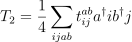
For example, the single excitation operator  is defined as:

and the double excitation operator  is defined as:
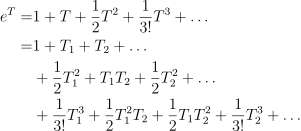
The exponential operator  can be expanded as:
The single excitation can be expressed as:

and the double excitation can be expressed as:
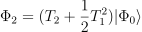
Return to the Schrödinger equation, we can obtain that:

Multiplying the equation by  from the left, we can obtain:

We introduce the effective Hamiltonian (similarity transformed Hamiltonian):

Therefore, the equation can be rewritten as:

By projecting onto excitation determinants, we can obtain:

where  is the excitation determinant.
The ground state energy can be expressed as:

The electronic Hamiltonian operator can be expressed as:

There are four terms in the one electron operator: OO, OV, VO, and VV. For the two-electron operator, there are 9 distinct terms: OOOO, OOOV, OVOO, OOVV, VVOO, OVOV, VOVV, VVVO, VVVV.
The effective Hamiltonian can be rewritten using Baker-Campbell-Hausdorff formula as:
![\begin{aligned}
\bar{H} = & \hat{H} + \left[\hat{H}, T\right] + \frac{1}{2!}\left[\left[\hat{H}, T\right], T\right] + \dots \\
= & \hat{H} + \left[\hat{H}, T_1\right] + \left[\hat{H}, T_2\right] + \frac{1}{2}\left[\left[\hat{H}, T_1\right], T_1\right] \\
& + \frac{1}{2}\left[\left[\hat{H}, T_2\right], T_2\right] + \left[\left[\hat{H}, T_1\right], T_2\right] + \dots
\end{aligned}](../_images/math/63555921f7bbabd44e05c0607c3cc4b832f2d3bb.svg)
knowing that:
![\begin{aligned}
\left[\left[\hat{H}, T_1\right], T_2\right] = \left[\left[\hat{H}, T_2\right], T_1\right]
\end{aligned}](../_images/math/30055c7165f89f8f9811c17c3488d9dcac5ffb21.svg)
Only the single and double cluster amplitudes contribute to the CC energy (that means only consider the contribution of single and double), and therefore the energy can be expressed as:
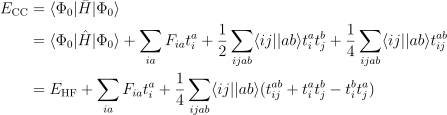
where  is the Fock matrix element, and
  is the two-electron integral. The
  equals to the Hartree-Fock energy
  .
.
CCSD
In CCSD, the cluster operator is truncated at the single and double excitation level:

and the wavefunction can be expressed as:

Projecting onto singly and doubly excited determinants, we can obtain:
![\langle \Phi_{i}^{a} | e^{-T_1}\hat{H}e^{T_1} + \left[e^{-T_1}\hat{H}e^{T_1}, T_2\right] | \Phi_0 \rangle = 0](../_images/math/2235c5e5e6b4cc2a88ba6d1bb1a9e1baff250999.svg)
![\begin{aligned}
& \langle \Phi_{ij}^{ab} | e^{-T_2-T_1}\hat{H}e^{T_1+T_2} | \Phi_0 \rangle
= \langle \Phi_{ij}^{ab} | e^{-T_2}e^{-T_1}\hat{H}e^{T_1}e^{T_2} | \Phi_0 \rangle
\\
& = \langle \Phi_{ij}^{ab} | e^{-T_1}\hat{H}e^{T_1} + \left[e^{-T_1}\hat{H}e^{T_1}, T_2\right] + \frac{1}{2}\left[\left[e^{-T_1}\hat{H}e^{T_1}, T_2\right], T_2\right] | \Phi_0 \rangle = 0
\end{aligned}](../_images/math/817cbf0b3eae99c43473bbfe7a419c4ca6e731ec.svg)
The energy can be expressed as:

CC2
In the CC2 method, the projection onto the singly excited determinant is the same as the CCSD method:
and the projection onto the doubly excited determinant is:
![\langle \Phi_{ij}^{ab} | e^{-T_1}\hat{H}e^{T_1} + \left[F, T_2\right] | \Phi_0 \rangle = 0](../_images/math/705519342c58457750dbd33dae84132e2ceb22ff.svg)
EOM-CC
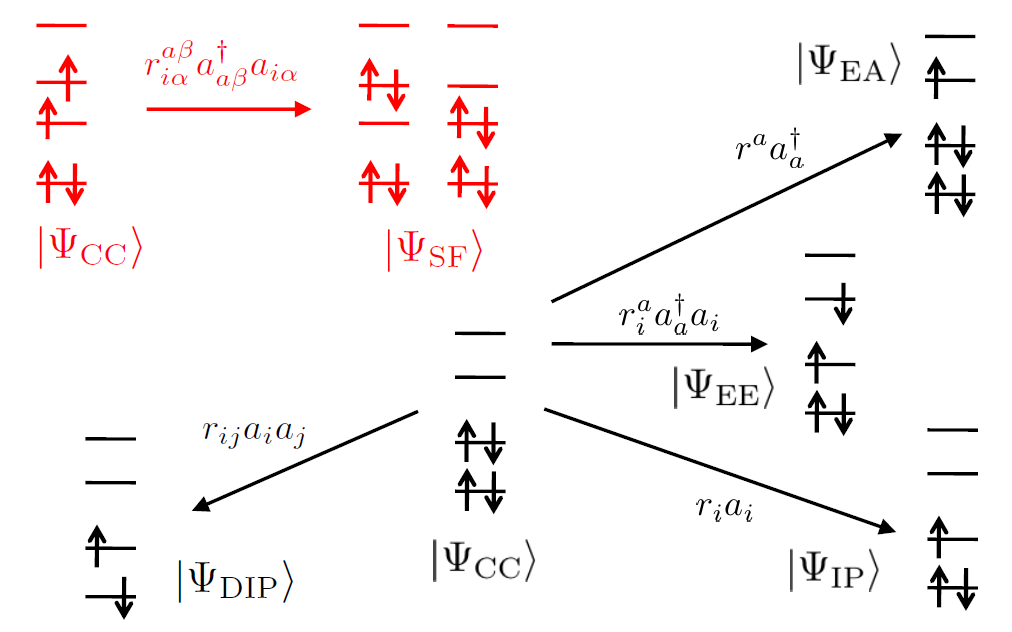
EOM-EE (Electronically Excited States)
Excited state can be expressed as:

where  is the excited state, and
  is the ground state.
  is the excitation operator, which can be expressed as:


The ground state is approximated by:

where  is an arbitrary Slater determinant, usually SCF solution.
Therefore, the excited state can be expressed as:

which means the right excitation operator and the cluster operator are commutative.
Inserting the equation into the Schrödinger equation, we can obtain:

The operator and operator are necessarily commutative, so we can rewrite the equation using the effective Hamiltonian operator  :
:

and then we can obtain the equation:

The goal of any EOM-CC calculation is to determine the energy difference between the initial and target states:

With the commutation relation between the cluster operator and the excitation operator , we can obtain the EOM-CC equation:
![[\bar{H},\mathbf{R}]|\Phi_0\rangle = \omega_k \mathbf{R}|\Phi_0\rangle](../_images/math/c8c3a8bef1c6f354501fb99fc5c364df54ebb7de.svg)
The effective Hamiltonian can be expressed in spin-orbital basis as:

Note that the CC wave operator is not unitary, so the effective Hamiltonian  is not Hermitian. As a result, each root of is associated with two eigenvectors, which are the left and right eigenvectors. The left eigenvector is defined as:

and the right eigenvector is defined as:

Note that the left deexcitation operator  is not commutative with the cluster operator . The left eigenfunction is defined as:

The left de-excitation operator can be expressed as:


The left and right operators satisfy the biorthogonality condition:

The two sets of solutions satisfy the biorthogonality condition:

If the C is unity, we can rewrite the equation as:

and therefore the energy can be expressed as:

Note that for ground state, we have  , so the energy can be expressed as:
The eigenvalues can be obtained by diagonalizing the matrix  in the basis of the reference, single excited and doubly excited determinants. The Jacobian matrix can be expressed as:
![\mathbf{A} =
\begin{pmatrix}
\langle\Phi_i^a|[\tilde{H}+[\tilde{H},T_2],\{c^\dagger k\} ]| \Phi_0\rangle & \langle\Phi_i^a|[\tilde{H},\{c^\dagger d^\dagger kl\} ]| \Phi_0\rangle \\
\langle\Phi_{ij}^{ab}|[\tilde{H}+[\tilde{H},T_2],\{c^\dagger k\}] | \Phi_0\rangle & \langle\Phi_{ij}^{ab}|\tilde{H}+[\tilde{H},T_2],\{c^\dagger d^\dagger kl\} | \Phi_0\rangle
\end{pmatrix}](../_images/math/53076f1351948cd26f239e668f6d77d341ac457a.svg)
For CC2, the Jacobian matrix can be expressed as:
![\mathbf{A} =
\begin{pmatrix}
\langle\Phi_i^a|[\tilde{H}+[\tilde{H},T_2],\{c^\dagger k\} ]| \Phi_0\rangle & \langle\Phi_i^a|[\tilde{H},\{c^\dagger d^\dagger kl\} ]| \Phi_0\rangle \\
\langle\Phi_{ij}^{ab}|[\tilde{H},\{c^\dagger k\}] | \Phi_0\rangle & \langle\Phi_{ij}^{ab}|F,\{c^\dagger d^\dagger kl\} | \Phi_0\rangle
\end{pmatrix}](../_images/math/3f93ad1d76b9f3711342ff142c77dcf264ad3904.svg)
And the whole eigenfunction can be expressed as:
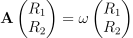

Then, the right and left eigenfunctions can be expressed as:
![\sum_{kc}\langle\Phi_i^a|[\tilde{H}+[\tilde{H},T_2],\{c^\dagger k\} ]| \Phi_0\rangle r_k^c + \sum_{klcd} \langle\Phi_i^a|[\tilde{H},\{c^\dagger d^\dagger kl\} ]| \Phi_0\rangle r_{kl}^{cd} = \omega r_i^a](../_images/math/c74b394e18f0e8e7bd05244c362a3d1971cd3da1.svg)
![\sum_{kc}\langle\Phi_{ij}^{ab}|[\tilde{H}+[\tilde{H},T_2],\{c^\dagger k\}] | \Phi_0\rangle r_k^c + \sum_{klcd} \langle\Phi_{ij}^{ab}|\tilde{H}+[\tilde{H},T_2],\{c^\dagger d^\dagger kl\} | \Phi_0\rangle = \omega r_{ij}^{ab}](../_images/math/6ec7ceb3bd0ba99af9f1e2c7a0f3ef652c585f00.svg)
![\sum_{ia}l_a^i \langle\Phi_i^a|[\tilde{H}+[\tilde{H},T_2],\{c^\dagger k\} ]| \Phi_0\rangle + \sum_{ijab} l_{ij}^{ab}
\langle\Phi_{ij}^{ab}|[\tilde{H}+[\tilde{H},T_2],\{c^\dagger k\}] | \Phi_0\rangle = \omega l_k^c](../_images/math/b0d73b937381f07101e9278f573b34c052ed5f5c.svg)
![\sum_{ia}l_a^i\langle\Phi_i^a|[\tilde{H},\{c^\dagger d^\dagger kl\} ]| \Phi_0\rangle + \sum_{ijab} l_{ij}^{ab}
\langle\Phi_{ij}^{ab}|\tilde{H}+[\tilde{H},T_2],\{c^\dagger d^\dagger kl\} | \Phi_0\rangle = \omega l_{kl}^{cd}](../_images/math/0b1327286bb25a3bf142bf7909787a6f40ef9b96.svg)
EOM-EA (Electron Attachment)
For EOM-EA state, the right excitation operator is defined as:

EOM-IP (Ionization Potential)
For EOM-IP state, the right excitation operator is defined as:

EOM-SF (Spin-Flip)
For EOM-SF state, the right excitation operator is defined as:

where  or
or  .
.
Derivative
General
The asymmetrized, perturbation-independent, deexcitation operator  can be expressed as:
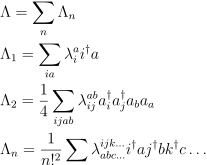
The  amplitude satisfies the condition:

Therefore, we have:

Finally the derivative of the energy can be expressed as:
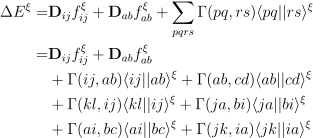
where the  is the relaxed density matrix, and the
  is the effective density matrix.
CCSD Derivative
The CCSD gradient can be expressed as:

EOM-CC Derivative
The derivative of the EOM-CC energy can be expressed as:

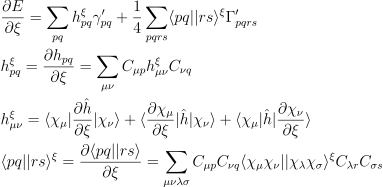
where: overlap derivative:

ERI derivative:


Fock matrix derivative:

Derivative of the MO coefficients:
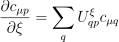
where  is the CPHF coefficient.
Relaxed density matrix:

Effective density matrix:
![\gamma_{pq} = \langle \Phi_0 | \mathbf{L}[p^\dagger qe^T]_c\mathbf{R} |\Phi_0 \rangle
+ \langle \Phi_0 | \mathcal{Z}[p^\dagger qe^T]_c|\Phi_0 \rangle](../_images/math/81d5a268b3e02c8745c353b9e61e883650e33915.svg)
![\Gamma_{pqrs}
= \langle \Phi_0 | \mathbf{L}[p^\dagger q^\dagger sr e^T]_c\mathbf{R} |\Phi_0 \rangle
+ \langle \Phi_0 | \mathcal{Z}[p^\dagger q^\dagger sr e^T]_c|\Phi_0 \rangle](../_images/math/0baa1007980d63a535ee13d04892e807e422b828.svg)
where  indicates the limitation to connected diagrams.
Auxiliary deexcitation operator  :
:


Lagrangian of EOM-CC derivative
The EOM energy can be expressed as:
The full energy derivative can be expressed as:

The first term is the Hellmann-Feynman contribution:
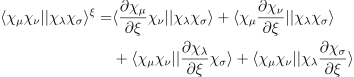
The EOM energy is stationary with respect to the left and right eigenvectors, so the second and third terms are zero:

Then there is so-called amplitude response  and orbital response
  .
.
The Lagrangian derivative can be expressed as:
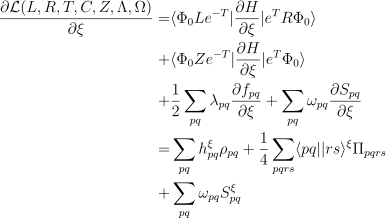
The effective density matrices  and
and  can be expressed as:
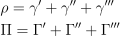
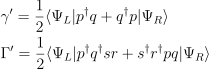
where the  and
and  are the so-called non-relaxed density matrices:
and  and
and  are amplitude response contributions:
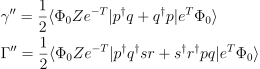
and  and
and  are orbital response contributions. is related to the Lagrange multiplier , and is related to and
  .
.
Properties
Different CC2 variants: