DecoAD
Decodense
Decomposition
Atomic energy decomposition
The energy of molecule can be decomposed into atomic contributions in the following way. First, the mean-field (MF) functional shared between HF and KS-DFT can be written as:
![E_{\text{MF}}(\bold{D}) = \sum_{\sigma=\alpha,\beta}\left(\text{Tr}[\bold{h}_\text{core}\bold{D}_\sigma]+\frac{1}{2}\text{Tr}[\bold{G}_\sigma(\bold{D})\bold{D}_\sigma]\right)](../_images/math/32040320515ad351c5cc362ade378f72196a4958.svg)
where  is the one-electron reduced density matrix (RDM1) for spin
  ,
,  ,
,  is the coefficient matrix for spin . When written without a spin subscript,
  is the sum of the RDM1s for both spins:
  .
.  is the core Hamiltonian matrix,
 .
.  denotes an effective Fock potential,
  . In HF method, the exchange ratio
  .
.
The Hatree-Fock energy can be written as:

where the  is the atom-specific RDM1s (atom-RDM1s):
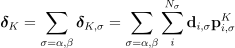
where the  is the orbital-specific RDM1s (orb-RDM1s),
 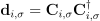 , and the
  is the population weight of an underlying
  -th MO on a given atom
  .
.
The nuclear contributions to the energy of atom are:
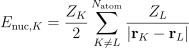
where  and
and  denote the nuclear charge and position of atom
  , respectively.
and the electronic contributions are:
![E_{\text{elec}, K} = \text{Tr}[\bold{T}_\text{kin}\boldsymbol{\delta}_K] + \frac{1}{2}(\text{Tr}[\bold{V}_\text{K}\bold{D}] + \text{Tr}[\bold{V}_\text{nuc}\boldsymbol{\delta}_K]) + \frac{1}{2}\sum_\sigma\text{Tr}[\bold{G}_{\text{HF},\sigma}(\bold{D})\boldsymbol{\delta}_{K,\sigma}]](../_images/math/a034c9d251ff129b988fe6109251c649aaeb8746.svg)
The population weight of an underlying -th MO on a given atom can be calculated using Mulliken population analysis:
![\bold{p}_{i}^K = \mathop{\text{Tr}}\limits_{\mu\in K}[\bold{d}_{i}\bold{S}]](../_images/math/736f65633aa88c67be4293ff682dda1fb1ea74ce.svg)
where the  is the overlap matrix of the basis functions.
Also, we can use IAO population analysis to calculate the population weight.
Atomic dipole moment decomposition
The dipole moment can be written as:
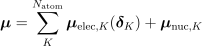
the electronic contributions to the dipole moment of atom are:
![\boldsymbol{\mu}_{\text{elec},K} = -\sum_r\text{Tr}[\boldsymbol{\mu}_r\boldsymbol{\delta}_K]](../_images/math/547d29c88d1693377fcbe1349e22a5551c81e418.svg)
and the nuclear contributions are:

Molecular Orbitals
Canonical
In Hartree-Fock theory, the pseudo-eigenvalue equation is:

where  is the Fock matrix:
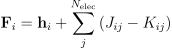
and the  is the canonical MOs. The canonical MOs are orthonormal and delocalized over the entire molecule.
Localized
A single Slater determinant composed of a set of canonical MOs can be written as:
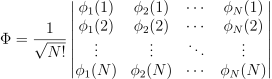
Other sets of orbitals can be chosen by forming linear combinations of the canonical MOs:


The goal of Localized Molecular Orbitals (LMOs) is to find a set of localized orbitals that are spatially confined to a relatively small volume, and therefore clearly display which atoms are bonded and have the property of being approximately constant between structurally similar units in different molecules.
A set of LMOs may be obtained by optimizing the expectation value of a two-electron operator  :
:
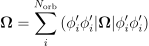
Foster-Boys
The Foster–Boys localization scheme uses the square of the distance between two electrons as the operator and minimizes the expectation value:
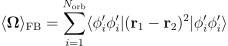
The minimization of  is equivalent to minimizing the sum of orbital contributions, each measuring the spatial extent of the orbital relative to the orbital centroid:

Pipek-Mezey
The Pipek-Mezey localization scheme corresponds to maximizing the sum of Mulliken atomic charges:
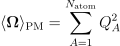
The contribution to atom A is given in:
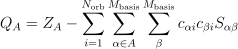
Population Analysis
Mulliken Population
The electron density  at a certain position
  from a single molecular orbital
  containing one electron can be written as:

The -th MO can be expanded in a set of normalized but non-orthogonal basis functions  , like:
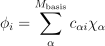
And the square of the MO will be like:
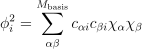
The total number of electrons can be obtained via integrating and summing over all occupied MOs:

where the  is the overlap integral of basis functions
  and
and 
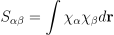
Now we introduce an occupation number  for each MO:

where  is the density matrix, which sums over the product of occupation number
  and MO coefficients
  :
:
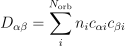
The Mulliken Population Analysis uses the  matrix to distribute the electrons into atomic contributions. In the matrix, the diagonal element
  is the number of electrons on the
  -th atomic orbital, and the off-diagonal element
  is half the number of electrons shared by the -th and
  -th AOs (another half is
  ). The
contributions from all AOs located on a given atom
). The
contributions from all AOs located on a given atom  may be summed up to give the number of electrons on that atom. However, the contribution of basis functions located on different atoms also need to be determined.
For Mulliken population analysis, the atomic contributions are partitioned equally between the atoms to which the basis functions are attached. Therefore, the Mulliken electron population of atom is given by:

The gross charge of atom is then:

where  is the nuclear charge of atom .
IAO
The MO can be expanded in a set of normalized but non-orthogonal basis functions, like:
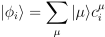
where  are basis functions from a large basis set
  . However, the basis functions
  cannot be clearly associated with any atom, also it’s often not on the atom it is placed on due to the ’s high variational freedom.
Also, we can expand the MOs over a minimal basis set  of free-atom AOs:
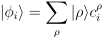
where  are basis functions from a minimal basis set . The basis functions
  are clearly associated with the atoms they are placed on. However, the wave function would be inaccurate, even qualitatively incorrect, since free-atom AOs contain no polarization due to the molecular environment.
Therefore, we propose to first calculate an accurate wave function  , and then to form a set of polarized AOs
  that can exactly express s occupied MOs
  .
.
For this, we first split the free-atom AOs  into contributions corresponding to a depolarized occupied space
  and its complement
  . Let
. Let
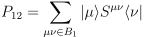
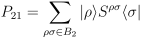
denote the projectors onto the bases and , respectively, the  and
and  are the inverse overlap matrices of the basis functions in and , respectively.
The depolarized MOs  are obtained by projecting the accurate MOs
  from the main basis set onto the minimal basis set and back.

Therefore, lies completely within the space spanned by  , and thus the free-atom AOs
  can be exactly split into one subspace corresponding to the occupied orbitals span
 and a second subspace corresponding to the unoccupied orbitals (virtual valence orbitals)
span
and a second subspace corresponding to the unoccupied orbitals (virtual valence orbitals)
span . To obtain the polarized AOs from the free-atom AOs
  , we simply project their contributions in
  and onto their polarized counterparts
  and
and  :
:
![|\rho\rangle = \left[O\tilde{O}+(1-O)(1-\tilde{O})\right]P_{12}|\tilde{\rho}\rangle](../_images/math/eb72542b3422ad92431003c22be884a2f65da4f9.svg)
Using polarized AOs , we can define atomic charges:
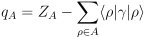
where  is the close-shell SCF density matrix:

is the nuclear charge of atom and represents the polarized AOs (IAO).
Auto Differentiation
Dipole Moment
The dipole moment of a molecule can be calculated as the first derivative of the energy with respect to an external electric field:

where  is the dipole moment,
  is the energy, and
  is the external electric field.
Polarizability
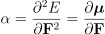
The polarizability of a molecule can be calculated as the second derivative of the energy with respect to an external electric field:

where  is the polarizability, is the energy, and is the external electric field. Also, it can be calculated as the first derivative of the dipole moment with respect to an external electric field: